COMPLY
Build the AI inventory the EU AI Act expects
A continuously maintained record of the AI in use, how each system is classified, and how you know, kept in Europe.
Every AI regulation assumes you know which AI you use.
A spreadsheet is accurate on the day it is written. Qastel keeps the inventory, the classification and the evidence current as your AI estate changes.
A live AI inventory
Your directory, network, agent platforms, gateway and managed browsers feed the register continuously.
Every system classified
Each system gets its EU AI Act risk tier as part of its assessment, recorded on the system itself.
Evidence you can hand over
Reports come from the live record, so an audit or a customer questionnaire is answered without rebuilding it by hand.
How Qastel does it
How it works, step by step.
Step 1
Discover continuously, from what you already run
Your directory, your network, your agent platforms, your gateway, and your managed browsers feed the inventory on a schedule. Every connector is read-only and never writes back.
Step 2
Classify every system
Governance state, policy coverage, data sensitivity, EU AI Act risk classification, and whether you have data-processing terms in place, recorded on the system rather than gathered once a year.
Step 3
Keep the provenance
Each system shows which sources reported it and when they last did. “We have no unmanaged AI in finance” becomes a claim with a date behind it.
Step 4
Export the evidence
Inventory and assessment data export as report artifacts, so an audit or a customer questionnaire is answered from the live record rather than rebuilt by hand.
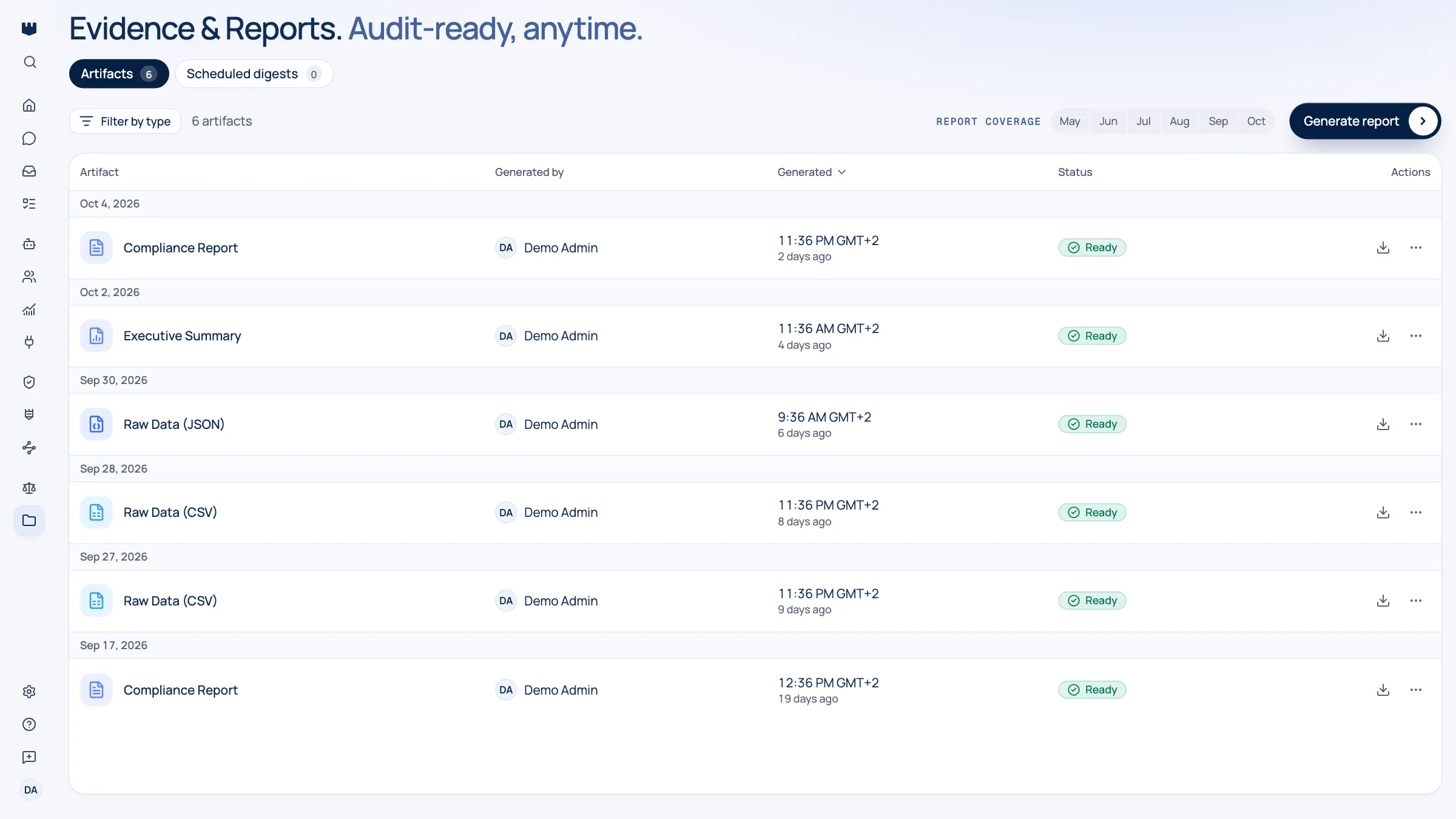
Audit and board reports
Reports for your auditor and your board, sent on schedule.
Generate a Compliance Report with your EU AI Act evaluations, or an Executive Summary of your risk posture, over 7, 30 or 90 days. A scheduled digest emails them to the people you choose.
- Report coverage by month, so a missing period is visible before an auditor sees it
- Daily, weekly or monthly, to up to 50 recipients
- Every report kept as evidence
Questions people ask.
What does the EU AI Act require of us, and how does Qastel help?
For an organisation that uses AI, the Act means classifying each AI system by risk, stopping prohibited uses, making sure staff are AI-literate and, for high-risk systems, assigning human oversight and keeping logs. Qastel maintains the inventory, the classification and the evidence trail you need to show for it. Interpreting your obligations stays with your legal and compliance teams.
Where is our data stored?
In the European Union. Residency, subprocessors, and our certification roadmap are set out in the Trust Center.
Do we have to connect everything before this is useful?
No. One source produces a real inventory; each additional one narrows the gap. The value is that the record is continuous, not that it is complete on day one.
How does Qastel classify risk?
Risk classification is one dimension of each system's assessment, drawn from what the product is and how it is used in your organisation. It is a starting position for review, not a legal determination.
Can we show this to an auditor or a customer?
Yes. Inventory and assessment data export as report artifacts, so a questionnaire is answered from the live record.
This describes what Qastel records and exports. It is not legal advice and it is not a determination of your obligations: how the EU AI Act applies to your organisation is a decision for your legal and compliance teams.
See it in action.
Get a 30-minute overview of how Qastel discovers, assesses and controls the AI used across a business.