
Covers every AI system, shadow AI included
Policies apply to the AI you approved and to the tools nobody approved, personal accounts included. A gateway only reaches the systems you route through it.
Control
Upload your AI charter once. Qastel turns it into policies and enforces them everywhere AI runs, on sanctioned AI and shadow AI alike. Every policy runs in monitoring first.
Qastel turns the rules in your charter into policies and applies them at the moment of use, on the AI you approved and on shadow AI alike.
Upload the document or describe a rule in plain language. Qastel drafts the policies, and you review them before anything is switched on.
In the browser, in desktop apps and in developers' agents, on each message, before it is sent.
A policy applies to tools nobody approved and to personal accounts. It first runs in monitoring and affects no one until you switch it to Enforcing.
From charter to policy
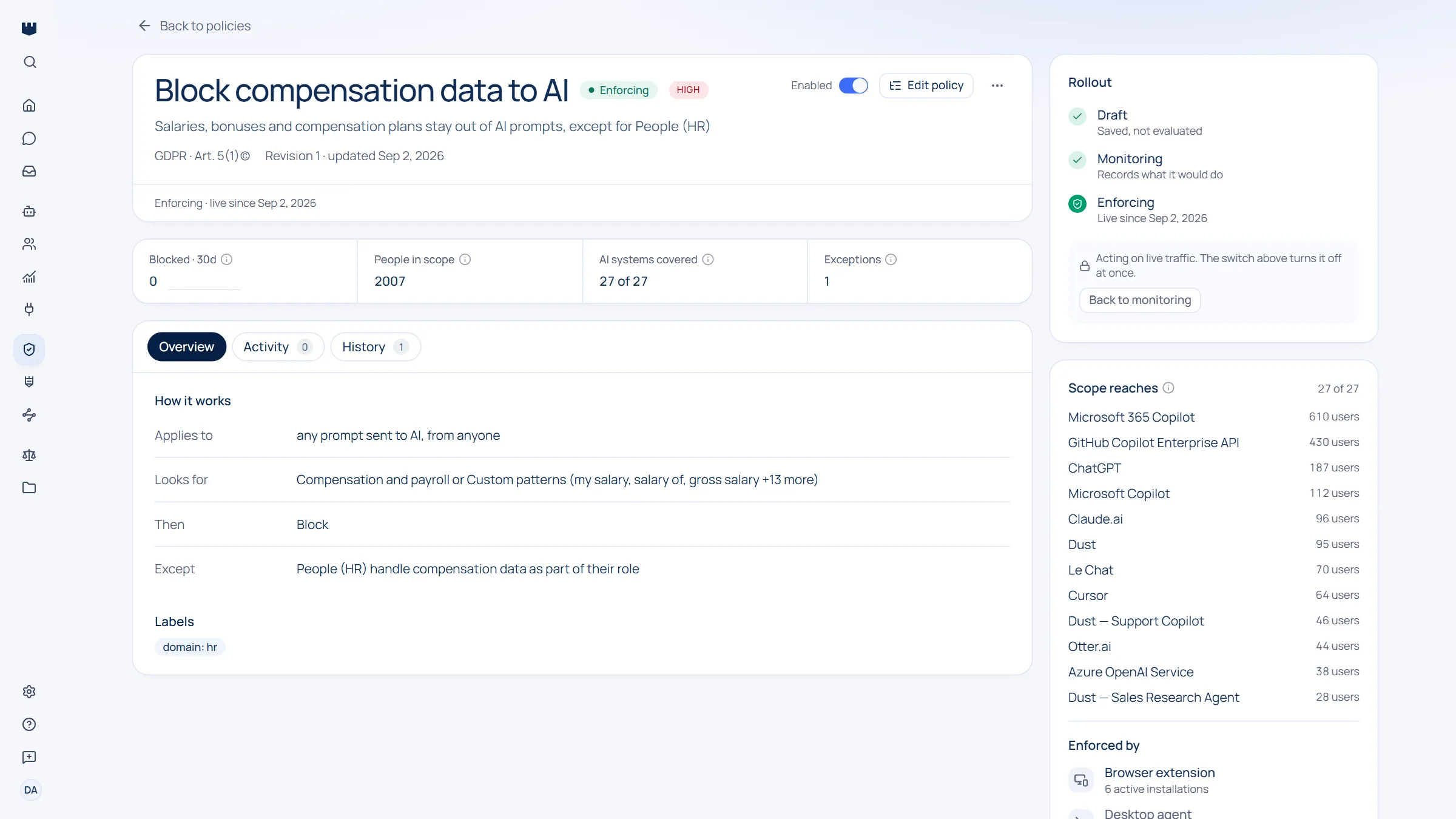
Each rule in your charter becomes a policy that names the data, the people, the AI tools and the kind of account it covers, with exceptions for the teams that need them. You review each one before it is turned on.
Shadow and sanctioned AI
A gateway only sees the tools you routed through it. Qastel applies your policies where AI is used: the browser extension on AI tools in the browser, the desktop agent on AI desktop apps and model provider APIs on Windows, and the MCP gateway on developers' agents.
For every team
The people who know where the risk sits write the rule. HR, Finance, Legal, Compliance, Sales and Engineering describe it in their own words, and Qastel turns it into a policy.
From HR: “Block employee personal data from any AI tool we have not approved.”
Qastel Guardians
Qastel Guardians review your AI estate, surface risks, recommend policies and prepare evidence, so your teams can govern AI without adding more manual work.
Qastel doesn’t just give you governance software. It gives you agents that help run governance for you.
See Guardians in actionReviews what sensitive data reaches your AI systems, who sends it and which policy caught it, then writes a report with its findings and method.
The Qastel difference
Policies apply to the AI you approved and to the tools nobody approved, personal accounts included. A gateway only reaches the systems you route through it.
Qastel analyses what is actually being sent or done, message by message, instead of only allowing or blocking access to a tool. The same tool can be fine for one use and stopped for another.
HR, Finance and Legal write their rules in their own words and approve them as Operators. IT keeps control of sources, users and deployment.
At Qastel's enforcement points: the browser extension for AI tools used in the browser, the desktop agent for AI desktop apps and model provider APIs on Windows, and the MCP gateway for developers' AI agents and the MCP servers they call. Where none is installed, a policy has nothing to act on, and its page says so.
Yes, with the Operator role. Operators write, edit and turn on policies and approve what the policy agent or a Guardian proposes. Admins keep the parts that belong to IT: sources, users and roles, the identity provider, data retention and the audit log.
No. To reach a decision, an enforcement point sends the text of a message to Qastel's policy service, which evaluates it and keeps only the record of the decision: who sent it, to which AI product, which policy and which check matched, plus a hash and the size of the content, never the content itself. Only text is checked: files and attachments are not inspected. Prompt analysis is a separate, opt-in feature, and it also processes prompt text in memory without storing it.
Connections to your identity provider and security tools are read-only, and an administrator of those systems sets them up. Enforcing policies needs the browser extension on managed browsers, the desktop agent on Windows or the MCP gateway, each deployed by IT. Qastel is hosted in the EU, in Paris, and the security overview, the subprocessor list and our DPA are published in the Trust Center.
No. Guardians are AI, and AI is probabilistic, so they never make an enforcement decision. A Guardian reviews a window of your AI activity when someone runs a review, writes a report and proposes policy drafts. Only policies, applied by a deterministic engine at an enforcement point, block, redact or warn, and nothing a Guardian proposes takes effect until a person approves it.
By default, an enforcement point that cannot reach Qastel in time lets the message through after about two seconds and records the failure. If you would rather fail closed, or change the timeout, Qastel Support can set that for you.
Get a 30-minute overview of how Qastel discovers, assesses and controls the AI used across a business.