AGENT GOVERNANCE
Govern the agents your teams build
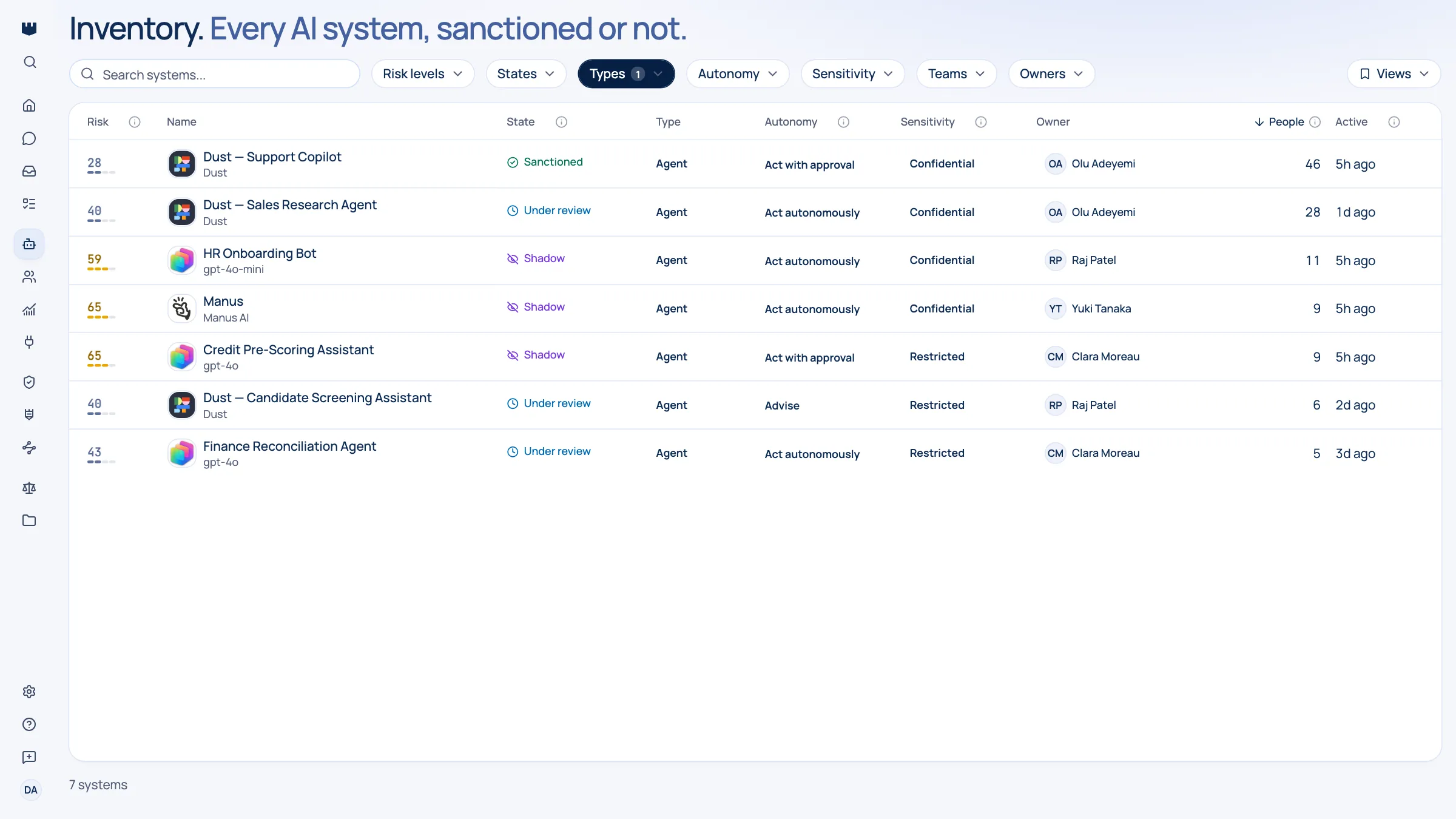
A live inventory of the agents your business built for itself: who owns each one, what it can reach, and how far it has spread.
The problem
Your AI estate now grows from the inside, one agent at a time.
Agent building has moved out of engineering and into the business. That is the value, and it means your AI estate now grows from the inside, assembled by people who were never asked to think about governance, wired to whatever data the builder could already reach.
Approving a platform does not govern what gets built on it. There is no central registry, because self-service is the whole point: an agent is created in an afternoon, shared with a team, and never filed anywhere. A list compiled by hand is wrong by the following morning, and agents routinely outlive the person who built them: the builder changes role, and an unowned system keeps answering questions.
The variable that actually predicts impact is reach. An agent shared with two colleagues is an experiment. The same agent shared with the whole company is a production system answering staff questions from whatever it was pointed at. Sharing is one click, so over-broad reach is the default outcome rather than the exception.
How Qastel does it
How it works, step by step.
Connect the platforms your teams build on
One read-only connection per platform enumerates every agent on it, including the ones that were never on anyone's list.
See what each agent is
Name, owner, where it lives, how it is configured, and whether it has been restricted.
Rank by reach
Qastel shows how widely each agent is shared, so you can work the estate in order of consequence instead of order of creation.
Give them owners
Agents are AI systems like any other in Qastel: they carry an owner, a governance state, and a risk assessment, and they appear in the same reviews. An agent whose builder has moved on shows up as unowned rather than disappearing.
Stay current
The inventory refreshes on a schedule, so an agent built this morning and shared broadly this afternoon is visible without another audit.
Questions people ask.
Which agent platforms are covered?
The agent platforms Qastel integrates with today are Microsoft Copilot Studio and Dust. Each connects independently, and agents from both land in the same inventory.
Does this cover automated workflows too?
Not today: it covers agents. Workflow coverage is planned, and we would rather flag that than let you assume it is included.
Do we need to know our workspaces first?
No. That is the point. A connection enumerates the platform for you, including the workspaces nobody registered.
Can Qastel disable a risky agent?
No. Qastel is read-only. It shows you which agents have the widest reach and the thinnest ownership; the action stays with the administrators of the platform it was built on.
How much work is the set-up?
An administrator approval and a role assignment per platform, which Qastel walks you through. Most customers are done in under fifteen minutes.
Does this work in sovereign or government cloud environments?
Not currently. The underlying agent inventories are not available in those environments, so we do not claim coverage there.
See it in action.
Get a 30-minute overview of how Qastel discovers, assesses and controls the AI used across a business.